Do you have more produce than you can eat, for example, an over-abundant fruit tree? Invite a team of volunteers to glean on your property - not only will you be preventing food from going to waste, that food can also feed people who might be food-insecure! Gleaning means to harvest leftover or unwanted food from a tree, field, or farm. Please see below for locations and organizations that would be willing to accept food donations or send out a gleaning team.
A lot of food waste prevention and food recovery work is going on in Sonoma County right now. Please visit our SB 1383 page to learn more about the law, and refer to the resources below for information on edible food recovery.
The Sonoma County Food Recovery Coalition (SCFRC) is a group of non-profit organizations, government agencies and individuals who are dedicated to creating a community where food is shared equitably and where there is a deeper understanding of the value of resources that go into producing our food.
SCFRC's vision for Sonoma County is to increase food recovery and reduce waste food for greater community connectedness and resilience. The SCFRC strives to reinvigorate the sharing ethic and strengthen community connections through:
In all that we do, SCFRC seeks to embrace diversity and cultural differences in our networks and our opportunities to serve.
The Sonoma County Food Recovery Coalition comes together as a network on a monthly basis to gain awareness of work we are doing in the community to advance increasing food recovery and reducing wasted food in Sonoma County. We share resources and information, and periodically come together to collaborate on joint projects/initiatives. Regular attendance at our monthly meetings is important, as well as actively engaging in group dialogue and sharing. Each member represents their individual and agency goals and advocates for those, while listening openly to others' input and ideas. We honor cultural differences in the work that we do.
Zero Waste Sonoma is a proud member of the Sonoma County Food Recovery Coalition.
1. Reinvigorate the Sharing Ethic
Sharing local food resources strengthens community resilience in times of disaster. Before you throw something out, think about how your neighbors might want or need that food!
2. Prevent Waste
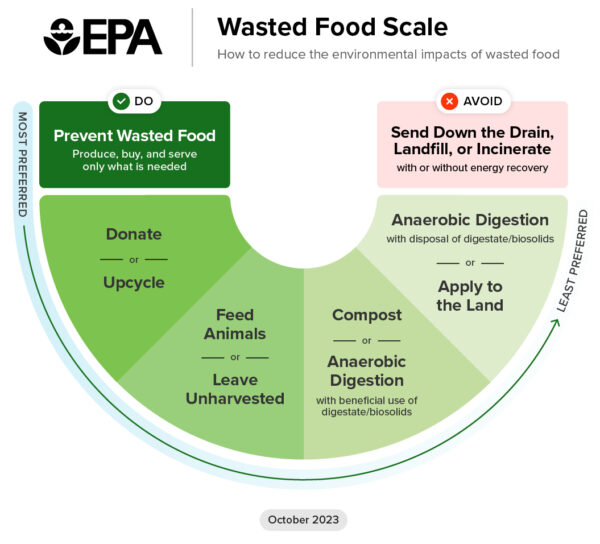
Forty percent of food produced in the United States goes uneaten -- that's at least 62.5 million tons of wasted food every year. In California, we are wasting about 5.6 million tons of food every year. This accounts for edible food from farm to fork, including the food that's left on the farm post-harvesting and packing, to food lost from manufacturers or processing, distribution, all the way to retail and food service, and at the household level as well.
In Sonoma County, food represents nearly 33% of a single-family residential waste stream. (see 2022 Waste Characterization Study) Nearly all wasted food can be either donated, composted or otherwise diverted from the landfill. For tips on how to compost your food scraps at home, see our Resources Page.
3. It's The Law!
California has passed legislation to prevent organic waste from going to landfill. Diverting wasted food from landfills not only conserves limited landfill space, but also reduces greenhouse gas emissions. In landfills, organic materials like food scraps and yard trimmings are broken down by bacteria to produce methane. Methane, a potent greenhouse gas, is shown to have a warming potential 21 times that of carbon dioxide, significantly contributing to global climate change.
Mandatory Commercial Organics Recycling (AB 1826)
Short-Lived Climate Pollutants Reduction Act (SB 1383)
Food date labels are an attempt to indicate quality, not safety. In fact, there are no federal regulations for date labeling for products other than infant formula.
According to the National Resources Defense Council (NRDC), Americans throw away approximately $165 billion worth of food each year, and for the average American family, that can be up to $2,200 per household. Click on the following links to learn how to reduce food waste in your household and keep it out of the landfill!
Yes, households are allowed to donate their fruits and vegetables to food recovery organizations. Donors are protected by the California Good Samaritan Act (AB 1219) (2017). For more information on gleaning, please see blow.
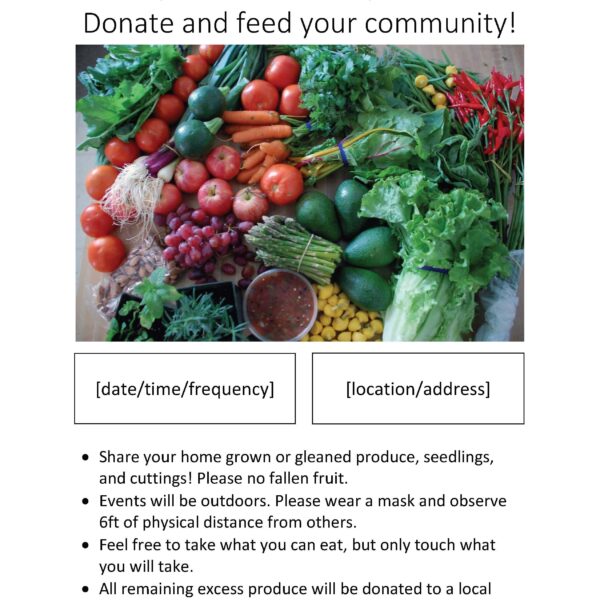
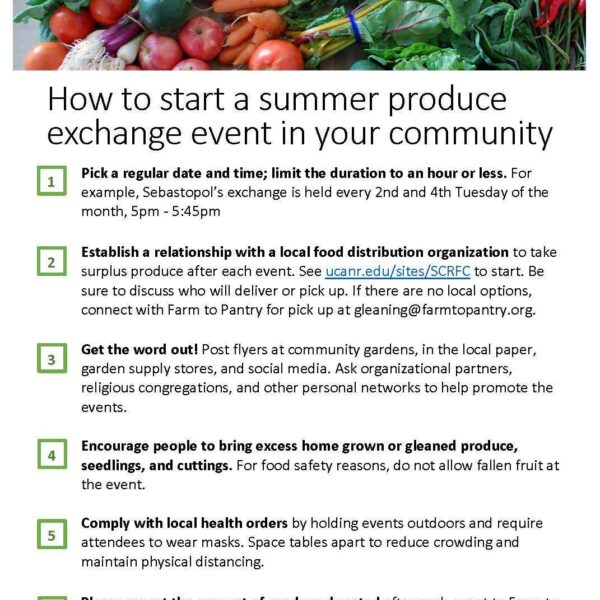
Help share the bounty of your summer vegetable garden with your community by hosting a Summer Produce Exchange. For information on how to start an Exchange, see "Download Resources" below.
With a resurgence of home and community gardening, it may be time to think about a summer produce exchange. The Sebastopol Grange started a successful event which is held twice a month in 2019. People bring their surplus home grown vegetables, fruit, and plant starts at 5 p.m. on a Tuesday, sharing with one another. Forty-five minutes later, Dena Allen, co-host, begins rounding up what’s left to take to the local interchurch pantry.
Now the Sonoma County Food Recovery Coalition is looking for other sites, especially community gardens, which might host a swap. While the emphasis is on building supportive neighborly connections among home food growers, extra produce again can be gathered and delivered to a local food pantry. Or a local gleaning or food rescue group can be engaged to pick up and deliver what’s left at the end of the event. Click here to see a Fall 2021 article on the Sebastopol Produce Exchange.
The following resources are provided in the English and Spanish language. Click on the image to download the file.